

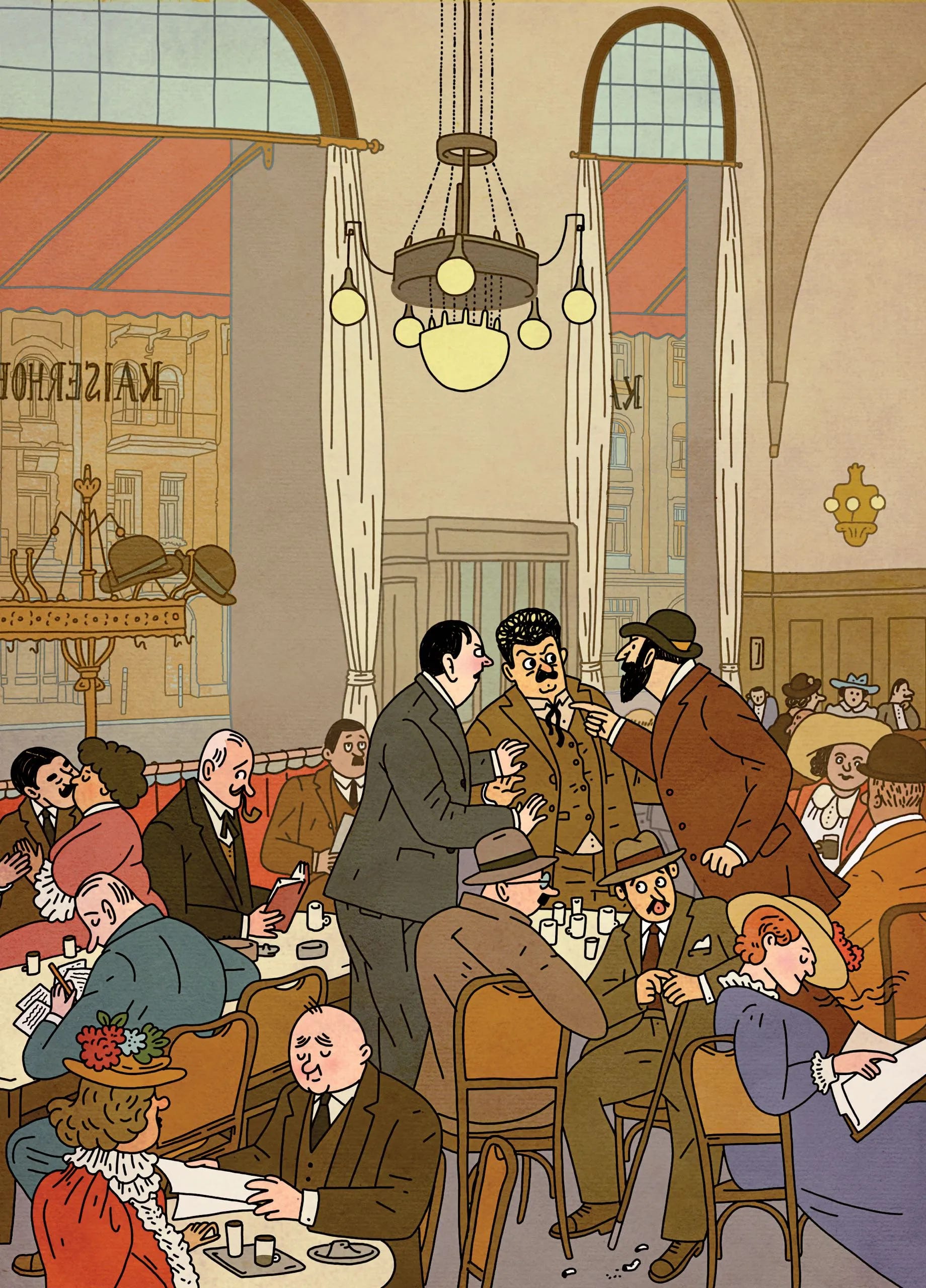
“Our ruling classes everywhere have no rational analysis or explanation for the immediate future. A small group of people have more concentrated power over the human future than ever before in human history, and they have no vision, no strategy, no plan.”
I. Introduction
The triumphalism around Mark Carney’s WEF speech — and the so-called death of the liberal order — is odd.
Carney’s main points were that we’re in an era of global rupture, so there’s no value in harkening back to the past, and that the liberal rules-based order was just a facade to cover the realpolitik that allowed strong nations to act freely in their own interests.
Many people, including those on the left (distinct from liberals), are feeling vindicated because they’ve been talking about the global order being hypocritical for decades. Too many reactions have been “see, we were right” or “the liberal order didn’t die today, it died with Gaza in 2023” — as if shame was a strategy.
In the past, I’ve written extensively about the hypocrisy of liberal discourse and the breakdown of the global system. But this reduction of the liberal order to only, or even primarily, a facade is problematic. If we take it seriously, we must wrestle with two pretty damning options: one, that we were so entranced that the cries of the oppressed couldn’t break the illusion, which doesn’t lend a lot of credibility to our cognitive and empathetic abilities; two, that we knew it was a mere magic trick but didn’t do anything about it.
So which is it?
And now that we have the approval of our overlords that this was indeed just a show that we all sat and watched, something in the real world is supposed to be different? Do we have permission now to do something about oppression and violence?
Surely people’s alarm bells should be ringing here. It’s naive to pretend that suddenly we’ve been welcomed into the room where it happens and that this is not simply the next act of the show. Somehow, the past was an illusion/facade, and the present is not. You have people quoting Gramsci at WEF — come on!
To treat the liberal order as a facade, and to pretend that with a mere snap of the fingers it’s now behind us, is not just irrational and reductive; it subverts longstanding traditions of resistance by playing into the hands of Power and Capital.
In this piece, I discuss what the liberal order actually is, the continuing problems with how we offer dissent, and what the next act could look like. I get right into it but if you want to read more about the theoretical framework and social context, I have some notes about them at the end.
“When change threatens to rule, the rules are changed” — Michael Parenti
[Like Gramsci for the first half of the 20th century, Parenti is probably the eminent left intellectual to read for the second half. Below is his iconic “yellow lecture”]
II. First tragedy, then farce.
Arnaud Bertrand, whose Substack on this got republished in Zeteo wrote:
“Who could have expected Mark Carney, a liberal establishment figure if there ever was one, to be the flag-bearer for the end of the US-led order? And from a podium at Davos, of all places?
The more you think about it, though, the more it makes sense.”
As Carney puts it, “when even one person stops performing, the illusion begins to crack” and the entire “system’s power” starts to crumble.
More than anything, what it means is that, to the extent it even existed at all, the West irremediably lost the Second Cold War: a Cold War requires two competing systems. Carney just announced that one of them simply no longer exists.”
It sounds like people think this speech is some acceptance of defeat and takes responsibility for decades of hypocrisy.
All because of Greenland, a few hand-wavy tariffs, and the discomfort of some leaders not following diplomatic norms?
And what are the two competing systems? There’s the liberal order, which apparently was a farce and not a real thing, and what else?
There’s a surprising lack of skepticism in all this commentary. Everyone should instead be asking why is a longstanding member of the liberal establishment, like the Wall St people mentioned above, finally willing to see the bad stuff? And why now!?
Why… now…
Material reality vs a facade
You might notice that most people don’t define what this rule-based order was or when it started. They will vaguely refer to a time when there were certain norms about what could and could not be done in geopolitics.
Grace Blakeley, a popular commentator on the left with whom I agree on many topics, but not this, wrote:
“For a period, liberal ideology was so dominant, and so widely accepted, that the rules of that system carried some legitimacy. They provided a common frame of reference for what counted as acceptable behaviour. Invading a country to spread democracy? That’s acceptable. Invading a country to access its resources? Not acceptable.”
For me, this definition doesn’t really hold up. Invasions, genocides, assassinations, regime changes, resource extraction, labor exploitation, etc., all continued with this period, but just because it was shrouded in certain language (democracy) vs other language (oil), we are supposed to believe it meant something.
A definition should be able to discretely identify what something is not. But when people talk about the liberal order in a way that makes it seem like a semantic and conceptual, rather than material, abstraction, that doesn’t hold. The world had all the same issues of power and exploitation before the liberal order came into existence. Grand notions of civility, purpose, cultural superiority, self-defense, etc., existed even then. Colonialism, for example, had a whole logic of rationalization and moral aggrandizement around it. There’s no question that the British Empire had an explicit civilizing mission that was global in both aspiration and reach. So then how does the liberal order as a conceptual model help? How is it something categorically different?
Carney said that they knew that this whole thing was a facade and that we need to stop upholding it. Grace said the same thing in her piece.
A facade implies that this ideology was merely veiling how things really worked. But who did not know that things worked this way? Again, were the multiple acts of violence, oppression, and exploitation, starting right after WWII, all the way up to Gaza today, not evidence enough?
This definition of the liberal order is wrong. And that matters, a lot.
There was no facade. There is nothing left to unveil. This is not an issue of information or of people needing to have their eyes open. Carney and others, liberals and leftists alike, argue that this was just a magic trick — a belief system — that is suddenly undone. Poof, and just like that, it’s gone.
We must stand against this reductionism.
Yes, the liberal order is falling apart, but is still very much alive. Rather than a facade, this system operates as a complex, tangible, and powerful web of agents, structures, and resources that cause violence and oppression.
It is a material system, not a semantic sleight of hand. It has a particular form and logic of how capital, labor, and trade operate. There is a global political economy around it.
That’s a key distinction: veil vs cause — facade vs scaffolding.
The system has worked not because of ephemeral stuff like belief, but because people around the world have vested interests. This isn’t just about “the West”; it’s about the global elite class and the professional-managerial class that serves them.
If knowledge of horrors were sufficient to drive change, it would’ve happened decades ago. Instead, as long as the spigots kept pumping out profits, no one, regardless of religion, ethnicity, or geography, batted an eye.
Class interests reign supreme.
Round and round we go
So when some leftists say that what broke the system was Gaza in 2023, they’re wrong. Where’s the evidence? What benefit did Gaza get if the system oppressing it broke? Then they’ll say that “Western hypocrisy” — curiously leaving out the hypocrisy of those much closer to Gaza — is now forever exposed. Okay, but did the deaths of 5 million people through invasions in the early 2000s not expose that? Where’s the evidence that there’s something fundamentally different about this time?
This is also why the commentary around Carney’s speech and WEF in general that criticizes the exclusion of Gaza and Venezuela from the narrative is so banal. Surely it’s our fault for continuing to have expectations from this class — there’s really no point in acting surprised and calling them out, as if shame, like belief, has any tangible impact.
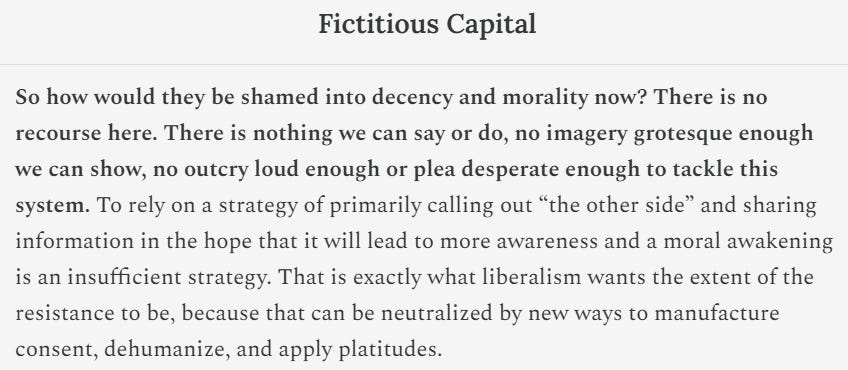
We really, really need to stop this trope of calling out the selective humanity of others. It’s tiresome, hypocritical, and not very graceful. I remember writing about the reaction to the Paris attacks 10+ years ago and how, all of a sudden, the Muslim world became obsessed with criticizing Europeans for caring about Paris but not about recent bombings in Beirut, while not speaking about it themselves up to that point. Our history is peppered by such moments.
If the global system was so painful and deceitful, why did we participate in it so fervently? Why did we, to this day, in an age of genocide, never criticize our own leaders and communities who actively enable and profit from this system? Did no one think the global system was hypocritical when Kushner, Clinton, and others spoke in Doha just this past year!?
Even God doesn’t help those who don’t help themselves.
Setting the stage for the next act
If I have successfully convinced you to be skeptical of narratives around the global order breakdown that are increasingly going mainstream, then the next question must be why are the elite doing this and why now.
In short, the material dynamics that underpinned the system have been cracking for a while. The socioeconomic and ecological contradictions of modern-day capitalism were inevitably going to lead to the system collapsing under it’s own weight. Therefore, as this plumbing frays, the spigots that pumped out profits for the elite are getting leaky.
At the same time, social discontent and violence is reaching escape velocity levels. The pitchforks are a systemic risk. Some in the establishment, like Carney and other Wall St types, can think two steps ahead and see what’s coming.
Therefore, this whole narrative that has been picking up steam over the past 1-2 years is an attempt to front-run the dam breaking, pretend that “the elite” is some other third party not affiliated with these people, and lay the foundation for things getting worse.
By doing this, they can absolve themselves of responsibility for the present and still be viable options to lead the reactionary phase. As I’ve written before, this is no upheaval of the system. Instead, this is an intra-elite struggle shrouded in revolutionary zeal.
“Instead, I think the current version of the right wing is the final stage of neoliberalism. We haven’t yet fully turned the corner from the system that has been in place over the past 50 years.” — newsletter #16
Sadly, the timing has nothing to do with resistance efforts — Gaza or otherwise. This is not happening because these people finally got a chance to go through the anti-colonial and anti-capitalist literature, or because they suddenly developed a conscience. Instead, this is just opportunism, self-preservation, and tactfulness to realize the Overton window is wide open.
This means that leftist triumphalism is unfounded. Despite best intentions and valiant struggles, it is not resistance efforts that brought us to this moment. Some might say it doesn’t matter as long as we’ve gotten to this point of mass recognition about the system. I think that is a mistake. The path is critical in shaping the essence of the destination.
It’s alive!
If you’re with me thus far, then you must also believe that the power structures that underpinned the past 50 years are still very much intact. They are, of course, evolving to deal with the changing dynamics, but they’re still there. And so Carney’s speech, and this whole narrative in general, must be seen as the next phase of those structures, not as evidence of their downfall.
That’s what neoliberalism has always done so well. It absorbs, adapts, and reterritorializes narratives and structures of resistance. Power structures, especially in the complex, post-modern world of today, are not static, ossified entities that can simply be broken. They are a dynamic, almost conscious, super-organism that recreates itself in new ways when under attack. Any celebration of resistance or progress that does not center this reality is premature and reactionary.
“The most powerful ideologies are not those that prevail against all challengers but those that are never challenged because in their ubiquity they appear as nothing more than the unadorned truth.” — Michael Parenti
III. What’s next
Another problem with the term “facade” is what it implies about the future. It makes it seem like we’re moving from illusion to reality, where the latter is some Hobbesian state-of-nature — the “law of the jungle”, as Grace Blakeley titled her piece.
Realpolitik.
This is not just inaccurate, but increasingly worryingly. It enables a form of raw power exhibition and domination without challenge, taking away even the aspirational platform on which any semblance of a cooperative, moral global system would be built.
Sadly, many leftists have adopted this unabashed realism as an ideological and analytical framework. Only Leusder of Last Resort has thus far provided a defense of “collective virtue” — that doesn’t mean returning to the liberal order, but also not giving up on the intellectual project of a better world.
It is reductive to force our understanding of the world to fit into false binaries of liberal collectivism and anarchy. Reality is much more complex, much more contextual, and our social essence as humans depends on having an imagination that goes beyond the trivialities of brute force as a primary civilizational principle.
And to connect it to my earlier point, falling into this mode of thinking, first pushed by right-wingers, is just an ideological cover for all sorts of ghastly exhibitions of power. It’s yet another use.
Historically, the world has always operated through a complicated interplay of norms, trade-based relationships, and the idiosyncrasies of political leaders. That didn’t change in the last 50 years, and that’s not going to change in the next 50.
Therefore, what is a better framework for the future is to realize that these factors I mentioned above are evolving. All drivers we’ve talked about in this newsletter for 3 years — rematerialization, social discontent, energy decline, etc. — are unequivocally changing the structure of our civilization. Our job is to recognize and chart those material realities, and then develop a new form of internationalist vision that has collective emancipation at its core.
Therefore, I actually think we will see a form of universalism that is more decentralized but with a continuing high-degree of interdependency across nations. European and Canadian willingness to accept Chinese technology is one example of that. As Tooze recently said:
“…the DNA of Chinese industrialism in its modern form has a very, very large component of Europe in it, in the same way as Chinese tech has a huge component of the United States in it. And they don’t, they don’t have any problem with this. They totally own this. They, they, they embrace it. They, they are deeply respectful.”
Let’s not fall for this crass realism and barbaric state-of-nature type logic. It’s dopamine-inducing, lower-order levels of thinking — a relic of the very system we’re trying to get rid of and mind-numbing, sterilizing nonsense that it fed us.
IV. Conclusion
To put it simply, these developments are an exhibition of my thesis from early pieces that we are seeing an intra-elite struggle within the broader context of trying to protect the status quo by redefining it. This is an attempt by the ruling elite to resolve the dialectic contradiction between the liberal order (thesis) and the unavoidable social discontent (antithesis) by shaping a new variety of neoliberalism (synthesis) that protects their interests.
This recognition is critical. The future is a multitude of potentialities, all of which come out of the present-day contradictions. Therefore, simply cause we may find ourselves standing on the precipice with other groups does not mean we stand together.
Our role is to critique, negate, and subvert this process unfolding in front of us — to be the antithesis to this emerging synthesis.
“In the courts of princes, in the drawing-rooms of the great, where success and preferment depend, not upon the esteem and intelligent and well-informed equals, but upon the fanciful and foolish favor of ignorant, presumptuous, and proud superiors; flattery and falsehood too often prevail over merit and abilities.” — Adam Smith
Appendix
Theoretical framework
To do that, let’s set the appropriate theoretical context. What do we know about the world?
Well, we know that power structures (people, institutions, ideologies) don’t just wither away or concede dominance; they have to be wrestled with and often end, to the extent that they do end, violently and unassuredly.
We also know that the neoliberal system (which people call the rule-based order) has always been remarkably effective at facing, sterilizing, and then absorbing dissent. Hence the Che Guevara t-shirt reference. A copious amount of literature and knowledge has been produced over decades that intricately described, analyzed, and offered resistance against all sorts of economic, political, and military violence. The post-ideological society that was created, coupled with deep economic insecurity, ensured that those critiques never really grew real fangs.
Most importantly, we, and here I look at leftists (not liberals), also know that history moves forward through the dialectic process (which I wrote about in newsletter #15). History is just not a series of cascading events; instead, we are in a constant struggle between evolving theses and their antitheses in order to take seemingly simple events and unearth complex truths within them. In simpler terms, rather than trusting a narrative, we must critique it and achieve a richer, more robust outcome through this process of negation.
Social context
This speech must be understood within the broader trend of a growing recognition at the elite level that something is seriously wrong. For example, over the course of 2025, Wall Street discovered poverty and inequality. Mike Green wrote a viral Substack that the real minimum income for a family of four to be comfortable in the US is $140,000, well above the ~$35,000 poverty line. There’s also been incessant discussions about the K-shaped economy and how the non-elite being left behind is a huge problem that needs immediate addressing.
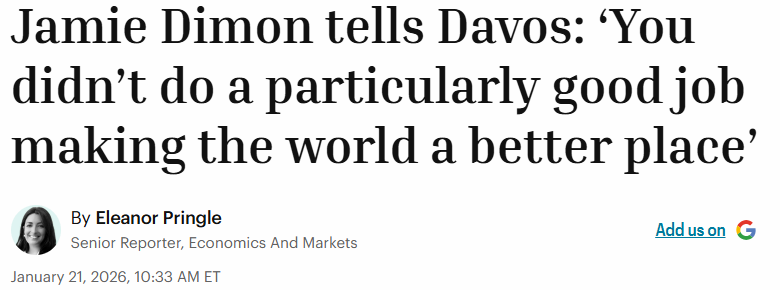

You also have Ray Dalio and Fourth Turning fans who’ve been calling for a system collapse, especially of the fiat monetary system, fuelled by debt and other things.
More than anything, just listen to the weekly roundup episode at the Forward Guidance podcast. You can see the emergence of the “social contract” / “global system” breaking narrative from quarters you wouldn’t really expect.
Lastly, the horseshoe theory is becoming rapidly popular, where people see the extreme ends of the right and left wings being much closer together than it may intuitively seem.
“If you closed your eyes and listened to Tucker Carlson talk on his new show or heard JD Vance talk on the Joe Rogan podcast, you could easily assume that a Marxist revolutionary is talking. They railed against the system, the liberal elite, and the rampant inequality that existed. They paid heed to people’s experiences. They validated the vibes.”
So Carney’s speech comes on the back of this growing wave of elites recognizing that the material issues in today’s world — poverty, inequality, violence, etc. — have fuelled social discontent to a level that cannot be contained through liberal narratives and institutions.
So why is this not a good thing? If more people, especially those with power and resources, want to do something about all these issues, shouldn’t we jump in?
No, we have to be very careful about understanding how and why this social context is being constructed. Taking these messages at face value is a ludicrous proposition when, on the other hand, we want to believe that the system, run by the same people all these decades, didn’t work.
Thank you!
Well, that's the same narrative that Nate Hagens is expressing. "Bend, but don't break." That's wrong!
It has to break.
And at the same time, as you said, a new, grassroots, local, parallel, maximally egalitarian structure has to emerge. A structure with a new meaning (ideology), although I don't particularly like the word "ideology" because it semantically reflects dogmatism rather than plasticity.
Since people all over the world cannot influence decision-making, have no autonomy to exist, have no ways to unite in the long term, cannot create means of violence and resist for a long time without slipping into the same hierarchical structures of coercion, it's hard to imagine how change can be achieved. Maybe we need a more favorable time? Because today's ways of obtaining benefits and access to goods and services, on a global scale, and especially in the "West", have not reached the point where the majority can refuse them, consciously and patiently endure deprivation and bloodshed on the way to something better. Today, for example, this is demonstrated in Ukraine. People silently choose to support their own genocide for the sake of a worthless piece of land with an area of 5,000 km2, losing sight of the fact that on the path of a slow retreat from it, the enemy will receive the same piece in another region of the country (Zaporizhzhya region) and destroyed infrastructure throughout the country (currently I have two hours of light a day), because no one talks about it in the media. As a result, the authorities forced people to choose a scenario in which we are bombed, and the war continues, due to the irrational position: "destroy the country in order to give up Donbas anyway." For men of draft age in Ukraine, this is real lawless slavery, and the system of constant mixing of troops, threats and violence does not allow for any resistance. In addition, there is the propaganda of patriotism, as well as ignorance, lack of awareness, etc. of the people themselves.
Perhaps, as a famous essayist rightly said, the only way to win is not to play.