

“If we want things to stay as they are, things will have to change.” — Giuseppe Tomasi di Lampedusa, The Leopard (Il Gattopardo)
This is not a piece I was expecting to write simply because there’s been too much hype around Zohran Mamdani to make any meaningful commentary, but the Trump-Mamdani meeting, and particularly the social media reaction to it, has presented a compelling opportunity to weigh in.
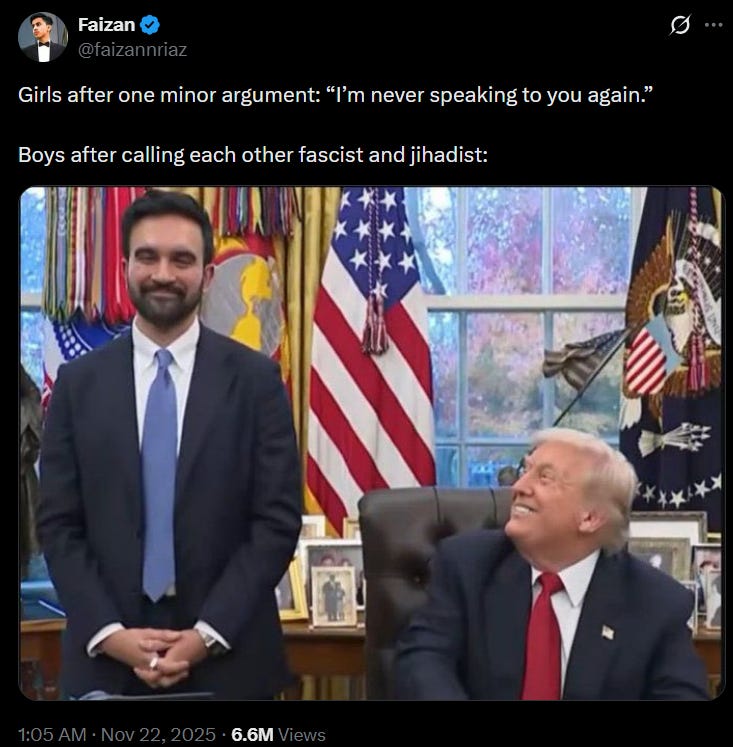
Unless you’ve been offline the past week, you’ve probably witnessed the myriad of takes about the bromance that was on display at the White House: confusion, surprise, compliments about 4D chess from Trump and/or Mamdani (depending on your, accusations of selling out, etc.
How can a democratic socialist / socialist / communist (depending on what version of Mamdani you’re referring to) have Trump gushing? Why is Mamdani offering a conciliatory tone to someone who served as the primary antagonist for his campaign (not to mention the F-word)?
It’s helpful to understand what type of politician Mamdani is to answer these questions.
In short, Mamdani is a shrewd operator with excellent oratory skills, a clear vision of what he wants, and a willingness to do whatever it takes. This also means that he’s a performer, eager and capable of playing the a broad variety of crowds by giving them what they want to hear. Without this critical element, there was no way he breaking into mainstream politics, but that is also why the cult of personality built around him, with a lot of hope riding on it, is a dangerous thing.
The second important element is his politics. He’s been described as a communist (back when he was dropping Marx quotes), as a socialist, and most recently as a self-labelled democratic socialist — which, for those not well-versed in these labels, is basically an old-school, European-styled liberal.
The third thing, which is my biggest compliment to him, is that as a long-standing Arsenal fan, he knows what it’s like to grind it out and be in the trenches. Few experiences in life can build more character than that!
My own assessment is that while the narrative around him, both as a compliment and critique, has been that he’s a revolutionary-esque figure seeking to undo the status quo, Mamdani is a reformist, not too disimilar to Bernie, AOC, and even Obama (back when that was the snakeoil he was selling).
He’s not here to undo the system, he’s here to change it just enough that it’s gross excesses and exploitative tendencies stop being so monstrously obviously. He’s here to keep the pitchforks at bay.
Within the reformist caricature, however, he espouses Abundance era energy — in that he brings something new and grounded in recent discourse.
“The Socialistic bourgeois want all the advantages of modern social conditions without the struggles and dangers necessarily resulting therefrom. They desire the existing state of society, minus its revolutionary and disintegrating elements. They wish for a bourgeoisie without a proletariat.” — Marx
To some, this refomer vs revolutionary claim will seem like intellectual obfuscation or a semantic distinction, but the difference between the two matters given the political context and what’s at stake.
In fact, I’d argue that in many ways he’s most similar to the most popular reformer of our generation: Trump.
[Important note: this piece is going to compare the political carcicatures of Mamdani and Trump, which is a combination of their respective political contexts and strategies, not to draw any false equivalence between the two in terms of character, integrity, personal beliefs, etc.]
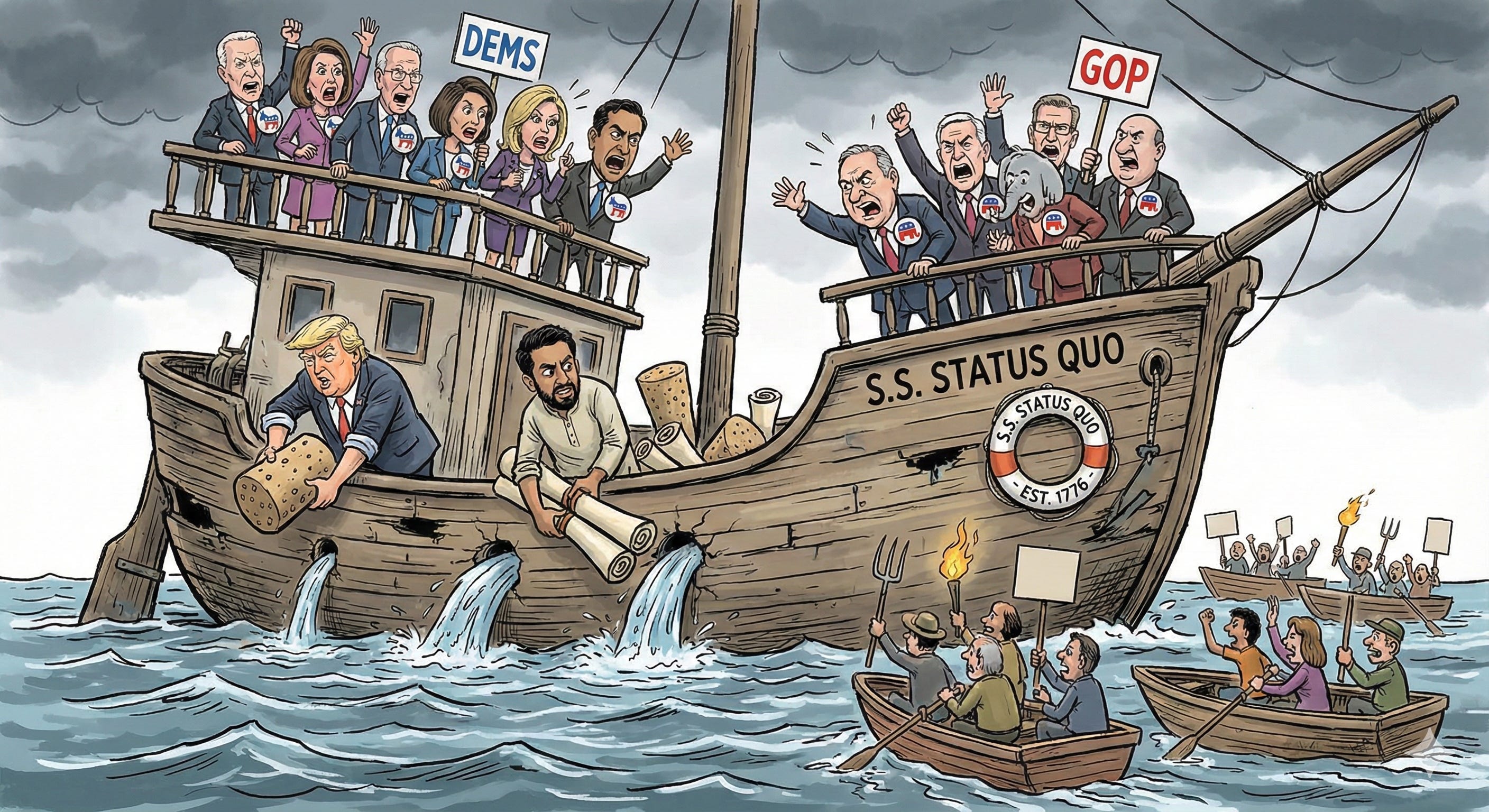
Similar to Keynes a century ago, these two are essentially members of the elite (Trump more industrial elite while Mamdani is the intellectual elite) who recognize that the system that has given people like them “the good life” is under threat from the growing polarization and discontent. They want to reform the system’s excesses, primarily through deploying state power to plug holes before the ship sinks. They don’t realize that today’s crises aren’t a failure of the system; they’re a necessary feature.
In leftist, dialectic terms, history moves forward when the breakdown of the status quo gives rise to it’s antithesis, which ultimately results in the synthesis (new dawn). Mamdani is not the antithesis to neoliberalism; he’s the potentially last wave of politicians trying to stop the initial breakdown (more on this at the end).
As individuals, their pragmatism and self-confidence disarms people, they are excellent at reading the vibes and are willing to cut through liberal BS to do what it takes. Both campaigned on affordability as the core message and weaved that into an impeccable performance tailored for their respective bases: Trump overplayed the social conservatism; Mamdani leaned heavily into the Muslim-brown-immigrant angle. They made lofty promises and campaigned in a way that riled up revolutionary zeal, but will likely settle for working within the confines and using the tools of the status quo.
This is a simplification in the interest of brevity since Trump as a person belongs to the neoliberal ruling elite, but his political persona is that of an outsider. For a more detailed argument, see #16.
To be clear, this isn’t necessarily a critique of them. Both deserve kudos for doing what needed to be done to cut through the barriers of entry into mainstream politics.
But that also means that as a society, we should be do better at being able to separate the performance from the policy. If we keep falling for the same theatrics, it’s not the politicians at fault. Instead, continously being enchanted by performativity and spectacles, especially those that rely so brazenly on identity politics and vibes, is our collective ideological failure.
The struggle lies ahead.
What comes next
In the current moment, these two personalities have become the paragons of US politics. It is hard to imagine anyone being able to win elections, not just in the US but globally (think Modi), without the playbook of affordability, outsider-grassroots vibes, a focus on localism, and providing a political platform for the masses to channel their growing anger and discontent.
The cost of living crisis / affordability / abundance has been a hot discussion point for the past 2-3 years now so of course every new candidate will try to make it their platform. Even Wall Street has discovered that poverty & inequality exist! (here’s a piece by Michael W. Green taking Twitter by storm — more on this soon.)
As I wrote last year, “state investment-led platforms that target inequality, shrouded either in far-right rhetoric that villainizes immigrants and promises a return to some pure past or anti-elite sentiments, are the only viable political strategy as liberal centrists lose support from all sides.” (#15)
How that will manifest though — in terms of undoing elite power structures and control over material resources — will be the defining struggle.
In terms of how US politics unfolds, here’s what to look out for.
For Trump, there are 2 questions:
Main Street over Wall Street?
To do this, he needs to find a way to tolerate significant pain from the stock market and the downstream effects on the economy.
Cut Israel off or not?
The growing anti-Israel sentiment, Trump’s pragmatic nationalism, and his personal ego offer the best chance of a major geopolitical shift — one that I think will be a strategic win for him at home as well.
For Mamdani, it’s not so much questions as risks.
Thus far, he’s been a politically shrewd operator and picked the popular stance for the right moment. But how far will he go in picking pragmatism over ideology?
His decision to keep NYPD Commissioner Tisch in office has already drawn criticism from people within his own camp. His transition roster in a motley crew of people including activists, organizers, lobbyists, private developers, bankers, etc. He’s also increasingly aligned himself with the Democratic Party establishment, even endorising the Zionist Hakeem Jeffris over New York City Council member Chi Ossé.
This is not to say that Mamdani is a sellout (he’s no Obama as yet) but he’s put himself and the people’s movement that brought him to office in a tough spot. If he can’t deliver on even some parts of his agenda, if he becomes yet another member of the political establishment (like AOC), and if he goes soft on Palestine, it will breed further discontent and disenfranchisement.
Some might say his recent moves have been tactical, that this is the only way to get stuff done and beyond past ivory tower politics. While I am sympathetic to that argument, it’s important to remember he’s not the first politician to try this. The status quo has enjoyed incredible dominance for so long because it adapts to absorb such threats.
Once you’re in the system, you’re subsumed and sterilized. No individual is going to undo that. No individual is going to reform the Democratic Party (cc: the squad). Mamdani’s dhoom machale vibes make many of us feel warm and fuzzy — and there’s value in that — but let’s not conflate that with material reality.
“Mamdani didn’t defy the system. He is what the system builds when it feels threatened: A controlled burn, a release valve. A politician who can channel anger without threatening order. Someone who gestures toward liberation while kneeling to the structures that make liberation necessary.” — Marwa Yousuf K. (source)
My expectation is that both Trump and Mamdani will fail to deliver simply because of the structural dynamics at play. Reformists are historically the transition between an established status quo and the more volatile, extreme (I don’t mean that pejoratively) revolution. It’s largely impossible to play by the system’s rules, operate within its confines, and use its tools to transform it.
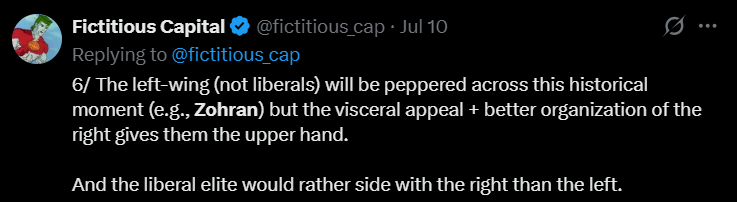
Therefore, when the hopes riding on both of them begin to dwindle and anger intensifies, that’s when the space for more ideologically-driven, no-nonsense movements emerge. I stand by my take from last year that simply given the decimation of socialist/communist movements over the past few decades while the conservative reactionaries have been allowed to get organized, the latter is more likely to succeed first.
As for Mamdani, the only thing to remember is that a politics of everything is a politics of nothing.
Beyond the political spectrum
I want to take this opportunity to write a little about the right vs left framing that plagues social discourse and why it is both ineffective and illogical.
The core problem is the prevalence of the political spectrum as a framework. Complex political dynamics have consistently been dumbed down to fit this notion that there’s a line that runs from “right-wing” to “left-wing”, with centrists in the middle. There really is no such thing. This isn’t a pedantic point; it’s simply an attempt to annihilate a framework that causes more confusion than offering any insight.
Liberals and leftists are two totally distinct groups that get clubbed under “the left”. Similarly, the MAGA right and conservatives are thrown under “the right”. I could go on. The point is that when you put Trump on one end of the spectrum and Mamdani on the other, obviously the meeting becomes confusing.
This has been happening for a while. I’ve talked a lot about how, over the past few years, Tucker Carlson, JD Vance, and others have sounded more Marxist than any liberal or democratic socialist out there. Commentators have attempted to explain this using the “horseshoe theory”, which is that the linear spectrum actually bends such that the two extreme ends land close together. Radicals on both sides are willing to unravel the system, which makes them unlikely but cooperative bedfellows.
I don’t buy that. It’s a bad way to massage the political spectrum framework to fit reality.
Let me give a quick recap of my previous arguments as context:
The (neo)liberal elite have been in power for the last few decades. In the US context, leaders across the two parties are part of this group — in fact, they have similar donors, similar vested interests, and hang out together once they’ve retired from performing at the political theatre.
Under this regime, inequality, polarization, well-being crises, and so on have surged. The K-shaped economy that everyone seems to be talking about suddenly has been true for decades.
Over the past decade, the cracks have become increasingly hard to conceal. Once a certain threshold of despair and discontent is crossed, tactics of identity politics and flooding society with dopamine-inducing slop stop becoming sufficient. While heterodox thinkers and politicians have been beating the warning drums throughout this whole period, Trump 1.0 was the first major candidate to blow through this facade and ride the wave to center stage.
Biden tried to follow the same playbook by focusing on industrial policy and throwing everything he could to address concerns around jobs and inflation for the masses. This is why he adopted such a broad array of potentially contradictory positions, including unleashing fossil fuel production, supporting clean energy, reshoring manufacturing, amping up hawkishness against China, supporting a genocide in Gaza, trying to protect social rights domestically, etc. Ultimately, the conventional Democrat thinking caught up with the admin, though, and they reverted to more conventional politics by cutting social safety nets and centering identity/rights-based platitudes.
Trump 2.0 is following the same playbook. Whether you agree with the policies or not, the intent is the same: use multiple arrows in the quiver, all based on state power, to address growing discontent and the material needs of people.
Therefore, rather than a crude left-right framing, it is more effective to think first in terms of cocentric circles, where the ruling elite — across the conventional political aisle — are in the middle, followed by the early reactionaries / reformers who are in effect a buffer between the pitchforks and the center circle, followed by increasing degrees of extreme alternatives (the pitchforks).
And within each layer you have a divergence in political ideologies across multiple dimensions, ranging from role of the state, private property and resource ownership, individual vs communal rights, religion, etc.
I’ll end here and pick this up in a future piece. Thank you for your attention to this matter!
"This is not to say that Mamdani is a sellout (he's no Obama as yet)."
Give Mamdani a picosecond, and he will be endorsing the same old Groundhog Day while the pizza lines form and cybertrucks dump greenbacks in front of the East River, where ICE officials take a hundred thousand to lease an immigrant to carry your Reiki-purified water.
Buy Simone Weil a cup of coffee (toast the moon).